
Starting Your Ketamine Clinic: Surviving the Infancy Stage (Years 0-2)
Synopsis: The infancy stage (years 0-2) of your ketamine clinic is about survival—financially, operationally, and personally. You're burning through runway, wondering where the patients are, and working 80+ hours between jobs.
This guide covers the three core challenges every new ketamine clinic owner faces:
Funding & Cash Flow - Calculate true runway, track cash weekly, avoid burning through savings too fast
Patient Acquisition - Build marketing basics, overcome ketamine stigma, nurture referral relationships
Burnout Prevention - Set boundaries, hire help sooner than comfortable, build support systems
KEY TAKEAWAYS
The infancy stage (first 0-2 years) is about survival. You'll face three core challenges:
- Funding & Cash Flow: Calculate 6-9 month runway, track cash weekly, keep overhead low
- Patient Acquisition: Build marketing basics, create educational content, nurture referral relationships
- Burnout Prevention: Set boundaries, hire help sooner than comfortable, find peer support
Bottom line: These challenges are predictable and solvable. Many have survived this stage—you can too.
Introduction
Six months ago, you reduced your hospital shifts to start your clinic. Today you're wondering if you made a huge mistake. You've only seen four new patients this past month, and you have yet to get a steady stream of referrals.
Every choice you make, you second-guess, researching and discussing with ChatGPT before making a decision. You're exhausted, spending 80+ hours between your old job and this new clinic. But while you're working away with a sense of dread, you're also actually quite excited about this adventure.
This clinic is your own. It's new, and despite everything, you still see a bright future ahead.
But "ahead" seems a lot farther away than you anticipated. Like many in this industry, you thought, "Hey, I'll help patients, be my own boss, and make a good living." While this could very well be true, it isn't right now. Because right now, you're not only a clinician—you're also the compliance officer, front office staff, and janitor. We see you and have been there, and many others like you have too.
Here's the good news: while you are currently the entire world for your clinic (just as you are an infant's entire world when they first enter this life), this stage in your clinic's life cycle is temporary and predictable.
The challenges you face in this stage are not only predictable, they're solvable with a little patience, guidance, and faith. You'll be able to survive this stage without sacrificing your sanity—for the most part. Although we jest, it's true you will feel like you're losing time, energy, and more in this stage. But many have done this before you, and so can you.
The Promise:
In this guide, you'll learn about the three core challenges in the infancy stage, along with proven strategies to not only survive but thrive sustainably during your clinic's infancy.
Let's dive in by double-checking if your clinic is actually in its infancy.

Ketamine clinic owner reviewing patient schedule during the infancy stage (first 0-2 years of operation). New clinic owners typically experience inconsistent patient volume, revenue that doesn't yet cover expenses, and the challenge of wearing every hat from clinician to marketer while questioning their decision to start a practice.
Are You In The Infancy Stage?
What does the infancy stage look like?
You've just opened your clinic, or you've been open less than two years. Of course, this is still a rough estimate. Similar to a newborn, your clinic is vulnerable and requires constant care. Everything either is or seems urgent. You're simply trying to make this work. If you were to boil down this stage into one word, it would be "survival."
You're here if:
You're in the first two years of operation
Your patient volume is inconsistent (two treatments one week, a rare eight treatments in another)
Clinic revenue doesn't cover expenses yet
You're still at your old job with reduced hours or have a second gig to cover personal expenses
You wear every hat: clinician, marketer, scheduler, biller
You question this decision weekly (or daily)
You're burning through your startup capital a lot faster than you had planned
Sleep and free time have become scarce
Not sure if this is your stage?
If you're thinking, "Hey, this doesn't really fit me. We've been open 18 months and we have regular revenue and our systems are pretty solid," well then you may be transitioning into the teenage stage. Not fitting perfectly into a stage is to be expected and normal. Focus on the things that are most important and pressing to you right now.
Now that you've confirmed the infancy stage is indeed where you are, let's explore what makes this stage so challenging. You might be surprised by what you find.
Want to see the complete picture of all six clinic life cycle stages? Check out our comprehensive guide: What Stage Is Your Ketamine Clinic In? A Complete Guide.
A few things to note: stage timelines vary. Your location or personal circumstances may extend your infancy period. You can get stuck in a stage or regress to an earlier one. Socioeconomic shifts, political changes, or even a car bomb explosion (in our case) can pause your advancement.
But advancement isn't the goal. The goal is to make informed, value-based decisions at whatever stage you're in.
Many of you are probably in the first or second stage, as ketamine therapy is still a growing industry. However, some of you may be in an accelerated life cycle.
What does that look like? Some clinic owners discovered private practice wasn't for them, or they were busier than they realized, and exited their practice. Others were approached by private equity and acquired.
But before we get ahead of ourselves, let’s dive into each stage in detail.
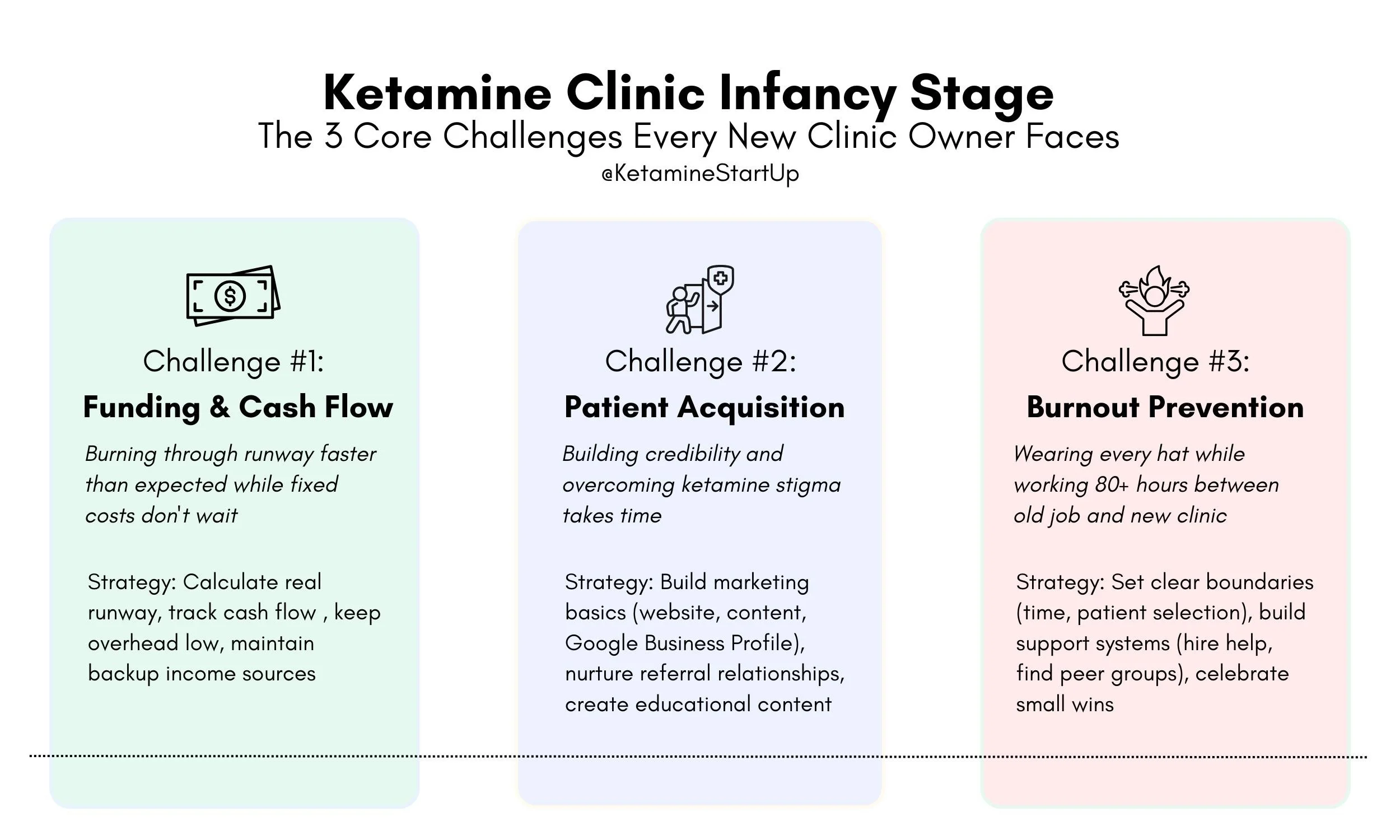
The three core challenges every ketamine clinic faces in the infancy stage: funding and cash flow management, patient acquisition and credibility building, and burnout prevention while working 80+ hours between old job and new clinic. These challenges are predictable and solvable with proper planning and support systems.
The 3 Core Challenges Of Infancy
Caring for a newborn can be scary, let alone a newborn business. That feeling that you're one mistake away from disaster or that you're going to let everyone down with a misstep is real. Although you may be feeling anxious, lost, or wiped out, the beauty of this stage (and frankly each stage) is that they each contain predictable challenges.
Those before you—including us and other entrepreneurial colleagues like yourself—have faced these challenges and overcome them. Getting a handle on what these challenges are can allow you to plan, strategize, and avoid or minimize mistakes in these critical early months.
Regarding legal and compliance challenges:
Before we go over these major challenges, we want to take a moment to state we aren't going to cover the legal and regulatory compliance challenges, which are a huge aspect of creating a private practice. We have much on this topic in past blog posts and podcast episodes. Feel free to check out the resources below, but remember these posts and episodes can never replace business and legal advice from licensed professionals:
Licensing & Credentialing:
What Licenses Do You Need to Open a Ketamine Clinic? (blog post)
What Licenses Do You Need to Open a Ketamine Clinic? (podcast episode)
What Specialties Can Provide Ketamine Treatments? (blog post)
Physician Presence Requirements:
Does a Licensed Physician Need to Be Present During Ketamine Infusions? (blog post)
Does a Physician Need to Be Present During Ketamine Infusions? (podcast episode)
Compliance & Risk Management:
Essential Risk Management: DEA Compliance & Insurance for Ketamine Clinics (Episode 42 - highlights from experts)
Ketamine Clinic Insurance: Expert Insights with Canyon Clifton (Episode 34 - full interview)
Mastering Clinic Compliance: Insights from Retired DEA Agent Dennis Wichern (Episode 23 - full interview)
State Regulations:
Challenge #1: Funding & Cash Flow (The Fuel Problem)
Starting a business, let alone a private practice, requires funding. Startup costs can be higher than you expect and can range from $75,000-$150,000. When you're just getting started, you won't have that steady stream of patients that will minimize burning through your runway (your startup capital). Plus, your revenue projections may be off, or you have unexpected expenses you didn't plan for. The cash you came in with (the capital) plus any cash coming from treatments are the fuel of your infant clinic.
We're preaching to the choir saying this is a tough challenge. It's even one you probably anticipated and planned for, which makes it all the more emotionally difficult. There are so many factors outside of your control, such as how fast you acquire patients. The stress of knowing your fixed costs—like rent, insurance, and staff wages—don't wait for you to finally break even or turn a profit. Let's not forget about your personal expenses either. The mortgage on the house is still there, your kid now needs math tutoring, and your aging parents might need to be moved to assisted living.
Watching your savings disappear, you feel pressure to "start seeing anyone," and that can lead to poor decisions like taking on patients you aren't ready for or who aren't a good fit for your practice.
So it's no wonder you question your decision to start a clinic so often. So what is an entrepreneur parent of an infant clinic to do?
Actionable Strategies to Address Challenge #1:
A little planning before you begin, followed by tracking your numbers once you've started, can help you face this challenge head-on. So let's look at each:
Before you open:
Calculate the real runway: how much money do you need per month to run your new clinic (your clinic expenses) PLUS cover all your personal expenses. Have at least 6-9 months of runway set aside or prepare to fund.
Identify potential additional funding sources if needed.
Keep your current job if possible, or switch to per diem.
Keep your overhead low: find a small place, sublet, have minimal staff, etc.
Decide if you're going to start out cash-pay only or take insurance/care credits, etc., which can lead to reimbursement delays. If so, take the delay into account in your runway calculation.
Once your clinic is open and operating:
Track your cash flow: the money coming in from treatments against your clinic expenses. Use QuickBooks or a simple spreadsheet like Excel or Google Sheets.
Calculate your break-even number: how many treatments do you need to provide per month to cover all your expenses?
Identify the unexpected costs that have occurred and update your runway calculation. If you're burning through your cash faster than expected, start looking into the other potential funding sources you identified before you opened.
Don't use discounts as a means of marketing or to gain popularity. It's a race to the bottom and is ultimately unsustainable.
Our experience:
Both of us kept our current jobs before opening our clinic. Sam was working per diem at three different emergency rooms, and Kim was working 0.5 FTE at an academic center in ophthalmology. We had been tracking our personal expenses for years by then, so calculating our true runway was pretty straightforward.
We found a small location of about 720 square feet. We did everything ourselves and were open by appointment only, thus keeping staffing costs down. When we opened our clinic in 2018, no insurance was covering ketamine infusions, so we knew we would be starting a cash-only practice.
In our first month, we had only four treatments. That was roughly one treatment a week. Luckily, our overhead was low, and we had expected not to break even in the first few months. We'll be honest: did we actually calculate and set aside a six-month runway for our business when we first started? Of course not! We didn't really know what that was when we started out.
However, we did calculate our starting costs and knew we would be using our savings to fund our infant clinic. We understood that if business was slow, our current jobs would not only be covering our personal expenses but potentially funding our clinic until we broke even.
Eventually, we would have a level of cash flow and profitability that allowed us to leave our old jobs. But until that point, we knew we would need other means besides our clinic alone to fuel and fund our practice.
Really want to get into the nuts and bolts of revenue and expenses of a ketamine therapy clinic? Check out this two-part blog series where we answer the commonly asked question, "Are ketamine clinics profitable?"
Challenge #2: Patient Acquisition (The Credibility Gap)
You've read the ketamine treatment studies and have seen how effective they are. And although you know that any type of private practice takes time to get its sea legs, part of you believed that people would and should be lining up for your ketamine services. But where are the patients?
Even worse, potential patients and potential referrals may even be hostile to the idea of ketamine treatments. While ketamine infusion treatments are evidence-based care, ketamine itself has a huge stigma. There is and always will be some misuse or ketamine-related tragedy that gets covered in the media.
On top of that, you're the new kid on the block. Either you're new to the community in general (you've opened your clinic in a city where nobody knows you), or you're known to your medical community but not for providing this type of treatment (you're known for being an emergency medicine doctor, but you're starting from scratch developing your ketamine therapy reputation).
Building credibility takes time, and to remedy the issues of educating people about ketamine therapy and growing your medical reputation, you turn to marketing. But guess what? That also takes time plus money. So going back to Challenge #1, hopefully you had calculated your marketing budget into your expenses. Yes, word of mouth and referral relationships are part of marketing, but that's dependent on having patients, and you're still working on that. So you look at advertisements or educational information sessions open to the public, shelling out some serious dough for a full-page ad in the local newspaper or delicious catering for an open house—but then you had no new patients from that. So there goes money that didn't convert.
Your cash flow is dependent on getting patients, and not only that—consistently helping patients. So what are you to do?
Actionable Strategies to Address Challenge #2:
Credibility takes time, which translates to consistent patient flow takes time. So what can you do now? Build your marketing basics and plant your relationship seeds.
Build your marketing assets (this list is basic, and basic for a reason. You need to get these things up, and this slow period is perfect for you to work on them):
Build a professional website that has educational content for both potential patients and referrals—not just sales copy, but real content of value.
Claim your Google Business Profile. You probably already did, but have you completed your profile? When was the last time you posted an update? Do you have photos of your clinic?
Create some content like blogs or videos. This content shows expertise and also gives those who consume it an opportunity to get to know you.
Be where potential patients (and even referrals) are, such as social media, by repurposing blogs and videos into shorter-form posts or video clips.
Be on relevant lists and directories such as Psychology Today.
Remember to ask patients for Google reviews and testimonials.
Nurture referral relationships:
Reach out to or visit local psychiatrists, therapists, and other mental health professionals. Start there, and then you can reach out to others such as PCPs.
Create opportunities for educating your medical community (all the while providing you an opportunity to connect with these potential referrals), such as providing a lunch and learn on what ketamine therapy is and who is a good candidate for it, or hosting an educational open house.
Join local medical organizations and networks. Attend events and actually talk and connect with others.
Build your peer network. Fellow ketamine therapy clinics could also refer to you! Patients that may not be a good fit for them may be a great fit for you. Or the patient is moving to your city! Find other ketamine clinic owners by joining ASKP3 or by taking our Ketamine StartUp 101 course or Therapeutic Ketamine Delivery course—you'll automatically be part of the community.
Our experience:
When we first opened our clinic, our first haters were people we worked with—fellow physicians. But guess what? We still raise the eyebrows of fellow medical professionals who still see ketamine therapy as quackery despite legitimate scientific studies. Also, whenever there has been a ketamine-related controversy circulating in the media, we get an increase in negative comments, and concerns flood our inboxes or YouTube videos.
The ketamine stigma is real and is one that doesn't go away as you move through the various stages of your clinic. Therefore, we realized that as we were building our clinic reputation, we needed to create content that educated, but was also entertaining and inspirational. With low patient flow at first, we had time to make videos and blogs answering commonly asked questions about ketamine therapy. We would then repurpose this long-form content into shorter-form content like video clips and carousel posts. Consistently creating these videos and blog posts over months and then eventually years led to a thriving YouTube channel and connecting with people all across the world, with some even flying to us to get their treatment.
But not all our efforts were a success. We sent introductory letters to all the primary care physicians, psychiatrists, and other mental health professionals in our city—not a single referral. We dropped a couple thousand dollars for a feature in the popular local lifestyle magazine's health edition. We had a gorgeous two-page spread, and the patients we got from it were grateful, but we didn't recoup our costs of the feature.
Patience and developing a good reputation via happy patients, getting to know local providers, plus our online social media presence—we would eventually get a fairly consistent flow of patients.
Challenge #3: Burnout Prevention (The Sustainability Problem)
You're wearing every hat now that you're a small business owner. Obviously you're the clinician, but you also take patient calls, post the Google Business Profile updates, and even clean the clinic toilet. Sure, it was fun and novel at first, but you're pulling 80+ hour weeks because you're also still juggling your old stable job. You realize you're that meme: "Left my 9-5 job to create a 24/7 job for myself as an entrepreneur."
For a lucky few of you, your burnout will stem from the fact your clinic is very busy. You're having a good run with many patients. We've had providers who took our course and had full clinics in their first couple of months. But for many, if not the majority of you, you're burning out because of the intense focus you're putting into building your clinic.
Success (and even if you're not aiming for success, viability) requires not only intense effort but also focus. You fall into many false beliefs such as "If I don't do it myself, it won't be done the right way" or "I should be able to handle all this stress," especially in a culture that glorifies toxic hustle culture.
Actionable Strategies to Address Challenge #3:
Many of you (including us when we started out) are coming from a place of burnout or a desire to do something new. After all, if you were content in your current job, you wouldn't be starting a business. Therefore, we challenge you to adapt these strategies for other areas of your life to support you in overall well-being.
Set your boundaries:
Determine and outline what you're willing to give up or what are non-negotiable must-haves, such as attending your kid's baseball games, daily exercise, or prioritizing a minimum of six hours of sleep a night.
Block out personal time for self-care or, if that word doesn't resonate with you, "personal admin" in your calendar to schedule your overdue dental cleaning or finally sewing back on the missing button on your white coat.
Decide your clinic hours, and that includes both patient care and admin (emails, inventory, etc.).
Say no to patients who aren't a good fit for you and your clinic. If you're first starting out, you may not have the capability or capacity to take on complex patients, so saying no isn't about cherry-picking cases but rather about the patient getting the best care.
Build support systems:
Even though it feels like it's stretching you at times and contributing to the burnout, continue your per diem job. You can also consider reducing your FTE at the hospital.
Hire help sooner than feels comfortable (VA for admin, part-time MA for clinic support).
Find a peer group of other ketamine clinic owners (you need people who get it).
Consider therapy or coaching for yourself (you're under tremendous stress).
Celebrate small wins (first patient, first profitable month, first good review).
Our experience:
The excitement of starting a business of our own fueled us at first. The novelty of it all excited us and gave us the boost to work on our business in any gap of time we had. However, novelty wears off and turns into a grind. Burnout is not a challenge only at this stage—you're at risk of burnout at any stage. And that's why it's so important to start these actions in this stage, as they will help you develop strategies to prevent burnout during later stages.
These actionable strategies we share here come from our own hits and misses of addressing burnout during this early stage. We made a lot of mistakes saying yes when we should have said no to complicated cases. We're still guilty of working on emails late into the night, only to wake the next day to more emails and a feeling of not being rested. These boundaries we create sometimes have to be flexible or, rather, renegotiated when they are held and when they are flexed.
Regarding support systems: first off, we're here, and there is a growing community of support. When we first started out, there were few clinics and ketamine therapy providers. So our "community" became other entrepreneurs, and we turned to podcasts that supported our business development and education. We listened to How I Built This with Guy Raz and the Tim Ferriss Podcast. We slowly got to know more people in person in the early days through ketamine therapy conferences such as ASKP and Kariya.
A welcome, unexpected avenue for connection came from all the videos and social media posts we posted on Instagram and YouTube—other providers would find us and connect too.
These three challenges can seem daunting and scary for some. But the beauty is in knowing they are there and are predictable. When the burden of taking on these challenges seems insurmountable, you know that there are others out there who have faced them and have not only survived but thrived.
Here's a quick overview of the three core challenges you'll face in the infancy stage and what you need to focus on to overcome each one:
| Challenge | Core Problem | Why It Matters | Key Strategy Focus |
|---|---|---|---|
| Challenge #1: Funding & Cash Flow | Burning through runway faster than expected while fixed costs don't wait | Can't survive long enough to reach profitability without proper financial planning | Calculate real runway (6-9 months), track cash flow weekly, keep overhead low, maintain backup income sources |
| Challenge #2: Patient Acquisition | Building credibility and overcoming ketamine stigma takes time | Cash flow depends on consistent patient volume, which requires trust and reputation | Build marketing basics (website, content, Google Business Profile), nurture referral relationships, create educational content |
| Challenge #3: Burnout Prevention | Wearing every hat while working 80+ hours between old job and new clinic | Can't sustain the business long-term if you burn out in the first year | Set clear boundaries (time, patient selection), build support systems (hire help, find peer groups), celebrate small wins |

Ketamine clinic owner reflecting on surviving the infancy stage. Just like residency training or raising a newborn, the first 0-2 years of your ketamine clinic are temporary but foundational. With proper strategies for funding, patient acquisition, and burnout prevention, you can survive and thrive during your clinic's infancy.
Conclusion
For those who are parents, do you recall those sleepless nights? The colicky child that just wouldn't settle? It was painful and felt like it would never end. Or perhaps for those who don't have kids, how about those long overnight shifts during intern year—when you were excited to finally be a doctor and yet terrified, knowing how little you knew and not wanting to make a mistake or get yelled at by the senior resident or attending?
Ring a bell for anyone? Well, guess what? That's all behind you—it's in the past. That was a temporary time, but although painful and difficult, it was foundational to what you would later become.
And just like those times, so is this infancy period of your clinic. You survived those harrowing times in your training or raising your child, and you can survive and thrive in your business too.
As you navigate this challenging and exciting time as your business is growing, in those moments of doubt, confusion, or fear, return to your purpose.
What does that look like? It can look like on those difficult days, remembering what inspired you to take this leap or visualizing that person who gives you courage or for whom you're doing this.
You don't have to have it all figured out. All you need to have figured out is the next step in front of you. Mistakes are inevitable, but know there's a community out here to help you avoid the big ones and navigate the smaller ones. Trust in yourself to learn from them. You've got this.
Continue your journey:
Ready for the next stage? → Stage 2: Teenage Years (coming soon)
Revisit the life cycle overview: ← What Stage Is Your Ketamine Clinic In? A Complete Guide
Prefer audio? If you'd rather listen to this content on your commute, during a workout, or while reviewing your clinic operations, we have a podcast episode on this very same topic Episode 051 - The 4 Ketamine Clinic Business Stages: How to Know Where You Are and What to Do Next
Business Education Disclaimer: The following information is for educational purposes only and does not constitute legal, financial, or business advice. Regulatory requirements, licensing laws, and business practices vary by state and jurisdiction. Always consult qualified attorneys, accountants, and business advisors for specific practice decisions.
Frequently Asked Questions About the Infancy Stage
How long does the infancy stage of a ketamine clinic last?
The infancy stage typically lasts 6 months to 2 years, though this varies by clinic. You're in infancy if patient volume is inconsistent, revenue doesn't cover expenses yet, and you're still wearing every hat in the business. Some clinics move through this stage faster if they have strong initial patient flow or significant marketing budgets.
How much money do I need to start a ketamine clinic?
Startup costs typically range from $75,000-$150,000, depending on location, equipment choices, and whether you lease or own space. Beyond startup costs, you should have 6-9 months of runway saved—enough to cover both clinic expenses AND personal expenses while you build patient volume. Many successful clinic owners kept their previous jobs or worked per diem during the first year.
How do I get my first ketamine therapy patients?
Start with marketing basics: build a professional website with educational content, claim and complete your Google Business Profile, and create content (blogs or videos) that showcases your expertise. Then focus on referral relationships—reach out to local psychiatrists, therapists, and mental health professionals. Patient acquisition takes time because you're building credibility and overcoming ketamine stigma.
Should I quit my job to open a ketamine clinic?
Most successful ketamine clinic owners keep their previous job (often switching to per diem) during the infancy stage. This provides financial stability while you build patient volume and allows you to fund the clinic without burning through savings too quickly. Only go full-time when you have consistent profitability and enough runway to sustain both clinic and personal expenses.
How many treatments per month do I need to break even?
This depends on your specific overhead costs (rent, insurance, staff, supplies) and your treatment pricing. Calculate your break-even number by dividing total monthly expenses by your net revenue per treatment. For example, if you have $15,000 in monthly expenses and make $400 net per treatment, you need about 38 treatments per month to break even.
What are the biggest mistakes new ketamine clinic owners make?
Common mistakes include: underestimating how long patient acquisition takes, burning through runway too fast by not tracking cash flow, taking on complex patients before you're ready, using heavy discounts to attract patients (unsustainable), not maintaining backup income sources, and trying to do everything yourself instead of hiring help.
How do I avoid burnout while starting a ketamine clinic?
Set clear boundaries early: decide your clinic hours (including admin time), determine non-negotiable personal time (family events, exercise, sleep), and say no to patients who aren't a good fit. Build support systems by keeping your per diem job, hiring help sooner than feels comfortable (even part-time), finding a peer group of other clinic owners, and celebrating small wins. Remember: you can't sustain the business if you burn out in year one.
When should I hire my first employee?
Hire sooner than feels comfortable. Even part-time help (a virtual assistant for admin tasks or a medical assistant for clinic support) can prevent burnout and free you to focus on patient care and business development. Calculate whether the cost of help is less than the value of your time spent on those tasks—often it is.

Survive your ketamine clinic's first 0-2 years. Master funding, patient acquisition, and burnout prevention with proven strategies from clinic owners who've been there.


A review of the latest RCTs and meta-analyses on ketamine and esketamine for postpartum depression, including key evidence gaps and practice implications.